Para formar el presente continuo se utiliza el verbo auxiliar “to be” y el verbo+ing.
| Sujeto | Auxiliar (to be) | Verbo+ing |
|---|---|---|
| I | am | talking, eating, learning, doing, going… |
| he, she, it | is | talking, eating, learning, doing, going… |
| you, we, they | are | talking , eating, learning, doing, going… |
Structure (Estructura)
1. Affirmative Sentences (Frases afirmativas)
Ejemplos:
| I’m talking.(Estoy hablando.) |
| He’s eating.(Está comiendo.) |
| They’re learning.(Están aprendiendo.) |
2. Negative Sentences (Frases negativas)
Ejemplos:
| I’m not talking.(No estoy hablando.) |
| He’s not [He isn’t] eating.(No está comiendo.) |
3. Interrogative Sentences (Frases interrogativas)
Ejemplos:
| Are you talking?(¿Estás hablando?) |
| Is he eating?(¿Está comiendo?) |
Present Simple y Present Continuous se usan para acciones que ocurren en el presente. Present Simple se usa para describir acontecimientos diarios, hechos, o para narrar eventos contemporáneos. Present continuous se usa para acciones temporales y para describir lo que ocurre en el momento del habla.
Este apartado de gramática te propone una explicación comparada y ejercicios interactivos donde poner a prueba tus conocimientos.
Ejemplo
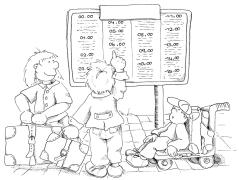
The Smiths are going on holiday. They usually go on holiday by train. They take a taxi to the station, check the timetable and get on the train.
At the moment, they are standing in front of the timetable. The train departs at 15:12 and arrives in Brighton at 16:45.
At 6 pm the Smiths are meeting Ben’s aunt in Brighton. She studies law in a London, but she is working as a waitress in Brighton during the summer holiday.
Uso
Esta tabla compara el uso del present simple y present continuous en inglés.
| Present Simple | Present Continuous |
|---|---|
sucesión de hechos
| ahora mismo
|
hora estipulada en un horario o programa
| citas, horarios personales
|
hechos cotidianos o regulares (always, often, never)
| hechos temporales, válidos a corto plazo
|
Present Continuous
El Present Continuous se emplea en inglés para:
- Describir acciones que están sucediendo al mismo tiempo que hablamos. Ej: He is having dinner right now.
- Hablar de cosas que están ocurriendo en la actualidad, aunque no sea necesariamente cuando hablamos, en este mismo momento. En este caso, se utilizan expresiones de tiempo como currently, lately o these days. Ej: He is currently looking for a flat.
- Situaciones temporales o que están cambiando progresivamente. Ej: With BrainLang I’m getting better and better at speaking English .
- Hábitos nuevos o temporales que normalmente suelen ser molestos y van acompañados de always. Ej: My flatmate is always leaving the kitchen in a mess!
- Hablar de eventos ya definidos que ocurrirán en un futuro próximo. Su uso indica que es bastante seguro que lo planificado sucederá. Ej: I’m going to the cinema tonight.
Present Simple y Present Continuous: ¿Cuándo usar cada uno?
El Present Simple se emplea en inglés para:
- Hablar de cosas que suceden de manera habitual, hábitos, hechos cotidianos o regulares. En este caso, suele ir acompañado de adverbios de frecuencia. Ej: I drink coffee every day.
- Referirse a afirmaciones generales o a hechos científicos. Ej: I like chocolate. Water boils at 100 degrees Celsius.
- Para eventos que van a ocurrir con seguridad en un futuro próximo, que suelen ser parte de un horario o programa. Ej:The train arrives at 10:00 .
- Para dar instrucciones en modo imperativo. Ej, Please, close the window.
- Para hablar sobre lo que sucede en la ficción de libros, obras o películas. Ej: At the end of the book, the detective catches the killer.

No comments:
Post a Comment